Cleaning your car is an essential part of this hobby. As these are mechanical moving parts, it is prone to collecting dust and other items that may cause binds - WE CALL THESE BINDING.
Typical examples are hair strands that collect in wheel wells and axles. Dust in gears that act like sand paper during continued high speed use thereby destroying gear meshing.
Gears
Do not over grease your gears. Instead before a race, dip all your gears in WD 40 or a similar brand of lubricant. The oil will stick to the gears thereby lessening the need for greasing.
Bearings
Dip your bearings in the lubricant as well after spraying with anti-static spray. Binded gears will heat up the plastic and loosen its hold. Worse, it may even break the bearing wells.
Dirt is the enemy of an efficient racing machine. The more dirt, the less performance from the motor or the batteries.
วันอังคารที่ 31 กรกฎาคม พ.ศ. 2550

Rollers

Rollers are a must when racing on walled circuits. They help your car negotiate corners smoothly. Key points in using rollers is their size, location and angle.
Handling Settings by Roller Size
Same size: Standard setting. Front and rear rollers have the same diameter. This makes your car easier to run straight since rollers are lined parallel when they contact a wall. Also minimizes power loss.
Bigger in front: Front roller diameter is bigger than that of rear roller. Suitable for courses with many corners since this pushes your car towards inside of the course when rollers contact a wall.
Smaller in front: Rear roller diameter is bigger than that of front roller. This makes your car run along with a wall. Gives stability during cornering, but creates power loss.
Remember, Double Ball Race Rollers are counted as one piece
Handling Settings by Roller Size
Same size: Standard setting. Front and rear rollers have the same diameter. This makes your car easier to run straight since rollers are lined parallel when they contact a wall. Also minimizes power loss.
Bigger in front: Front roller diameter is bigger than that of rear roller. Suitable for courses with many corners since this pushes your car towards inside of the course when rollers contact a wall.
Smaller in front: Rear roller diameter is bigger than that of front roller. This makes your car run along with a wall. Gives stability during cornering, but creates power loss.
Remember, Double Ball Race Rollers are counted as one piece
วันอาทิตย์ที่ 29 กรกฎาคม พ.ศ. 2550
Expert Advice - Wheels & Tires
Expert Advice - Wheels & Tires
Every Mini 4wd runs on wheels (how else would it run?) And on those wheels are tires. In the world of Mini 4wd, there are many types of wheels and tires. Different types of wheels can greatly affect a car. In order to start off, let's talk about wheels.
Wheels can be divided into four categories two types, and two sizes. The categories are normal wheels, one-way wheels, aluminum wheels, and lock-nut wheels. The types are small diameter and large diameter. The sizes are narrow and wide. Each of those wheels will be explained thoroughly below.
Normal Wheels
These are plastic wheels that comes with a Mini 4wd kit. They are simple, heavy, and shouldn't be used for a fast car. However, a few of the wheels that come with certain cars perform better than average normal wheels. These wheels get loose after pulling it off and putting it back on the axle a few times.
 One-Way Wheels
Wheels can be divided into four categories two types, and two sizes. The categories are normal wheels, one-way wheels, aluminum wheels, and lock-nut wheels. The types are small diameter and large diameter. The sizes are narrow and wide. Each of those wheels will be explained thoroughly below.
Normal Wheels
These are plastic wheels that comes with a Mini 4wd kit. They are simple, heavy, and shouldn't be used for a fast car. However, a few of the wheels that come with certain cars perform better than average normal wheels. These wheels get loose after pulling it off and putting it back on the axle a few times.
 One-Way Wheels
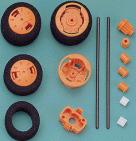
One-way wheels are made of plastic, but are a lot better than normal wheels. Normal wheels spin together at the same time. When it's time for a curve or turn, the outer wheel gets dragged, therefore slowing the car down. One-way wheels, on the other hand, has a special type of movement. Each wheel spins on its own, so that during a turn, the outer wheels moves faster than the inner wheels, allowing the car to pass a curve easier.
However, there are bad parts about these wheels as well. Just like normal wheels, they get loose after a while. One-ways wheels have many gears inside them, making it heavier, and creates a power loss. It is only recommended for technical tracks. Never use them on straight tracks!
However, there are bad parts about these wheels as well. Just like normal wheels, they get loose after a while. One-ways wheels have many gears inside them, making it heavier, and creates a power loss. It is only recommended for technical tracks. Never use them on straight tracks!
Aluminum Wheels
Aluminum wheels are definitely the best type of wheels you can find. Unfortunately, Tamiya doesn't make them. They are light and strong, and looks a lot better than any other wheels. They are either locked onto the axle with screws (the best type), or slipped onto the axle with a rubber tube inside the wheel, making them very dependable during a race. These are definitely the wheels you want for the fastest cars.
Lock-Nut Wheels
These are wheels that slip on, and are locked tightly so that it won't fly off during a race. When I say lock-nut, I simply mean any other type of wheel that can be tightly locked without being pushed on to the axle. Lock-nut wheels don't get loose, simply because it's not possible. This a type of wheel you should consider for straight tracks.
Now you know all the categories of wheels. You should be able to choose the right ones for your car. Remember, different tracks require different types of wheels. Now that you have the wheels, you'll need to know the types of tires that go on the wheels. Luckily, there's only two main types of tires, so it won't give you such a headache, and they'll be explained below.
Rubber Tires
These are tires that come with a Mini 4wd kit. It grips the tracks quite well. However, it is on the heavy side.
Reston/Sponge Tires
Reston/Sponge tires (from now on, will be talked about as "reston") are very light. They grip the tracks very well. But, they get dirty very easily, and require a lot of cleaning.
Rubber vs. Reston
Rubber and Reston are both great to use on a car, but which one is better? I would have to say: definitely rubber. Why? Let me give you all something to think about. Let's take two bicycles, one with fully pumped tires, and one with flatter tires. Two people rides them. The bicycle with the flatter tire grips the ground better, but the bicycle with the pumped up tire is fast, and easily pedaled. The person on the "flat bike" pedals as hard as he can, but the bike still isn't that fast. The person on the "pumped bike" pedals effortlessly. Get it now? If not, read on.
The flat tire bike represents reston, while the fully pumped tire bike represents rubber. The two people riding on the bikes are the motors. In other words, when you put a car with reston tires on a track, it is not only slower, but tires out the motor. On the other hand, a car with rubber tires can move very smoothly.
I would always recommend people to use rubber tires, no matter on what type of tracks. If you feel that the rubber is too heavy, you can always sand off a bit of it, which isn't hard at all.
Of course, since wheels have small diameter/large diameter and narrow/wide, tires have these selections too. What I'll be talking about below relates to both the tires and wheels.
Small Diameter vs. Large Diameter
Small diameter wheels/tires are good for technical tracks, as they lower the center of gravity. Large diameter wheels/tires are for speed tracks. So without knowing anything, you might think that large diameters are the best for a fast car. However, I wouldn't ever suggest using large diameter wheels/tires. They may be fast, but are only good with a weaker motor and a larger gear ratio (for example, 5:1).
Small diameters are supposidly fit with a stronger motor (more torque) and a smaller gear ratio (3.5:1). So small diameters would definitely be your choice for the perfect car.
Narrow vs. Wide
Narrow wheels/tires have less contact with the tracks, causing less friction and less drag, allowing the car to go faster. Wide wheels/tires have more contact with the tracks, causing more friction and more drag, allowing the car to be more stable, but slower. So, which type is better?
I would suggest using narrow wheels/tires on both the front and the back of the car. Narrows may not be as stable, but through my experiences, they work out just fine, and are faster than wides. However, if your car really appears to be unstable and tends to fly at times, try wide wheels/tires on the back.
Now you probably know a lot more about wheels and tires, and know how to pick the best ones. Good luck!
Motors
Every car needs a good motor to run well. The slowest Stock Motor will drop from a loop. The top-speed Plasma Dash might fly off a bridge. Fast motors are for straight tracks, normal motors are for technical courses, and Stock Motors are for trash. But don't expect to just put on the best motor and expect the car to do its best. A car might fly off the track easily. Also, when purchasing a motor, don't just consider the RPM, but also the torque. Torque is a very important aspect of a motor. Below is a list of every single Tamiya motor.
Making Your Own Motor
If you think putting a Plasma Dash on your car will get you first place in races, then your're very wrong. Yes, a Plasma Dash may be the best motor available, but that's not even a fourth as fast as a motor that you build yourself. What do I mean? I mean that you can wind your own armature, get some really strong magnets, a good electric brush, put them together, and TADA! You've now got a motor that goes over 70 kilometers per hour. It sounds easy, but it requires a lot of brainwork and patience. It can be very hard for beginners. This guide is for people who already know how to wind their own motors, but still have questions.
You must remember one thing, torque is good for technical tracks and uphills, and RPM is good for straight tracks. For more torque, you need stronger magnets and larger commutators. Thicker wire is good for top speed, requires less winds, but takes up a lot of battery juice. Thin wire, on the other hand, is slower, but uses less battery power. Using these options, try combining different wires with different armatures and different magnets. Each way is good, but it's all for you to discover.
Making Your Own Motor
If you think putting a Plasma Dash on your car will get you first place in races, then your're very wrong. Yes, a Plasma Dash may be the best motor available, but that's not even a fourth as fast as a motor that you build yourself. What do I mean? I mean that you can wind your own armature, get some really strong magnets, a good electric brush, put them together, and TADA! You've now got a motor that goes over 70 kilometers per hour. It sounds easy, but it requires a lot of brainwork and patience. It can be very hard for beginners. This guide is for people who already know how to wind their own motors, but still have questions.
You must remember one thing, torque is good for technical tracks and uphills, and RPM is good for straight tracks. For more torque, you need stronger magnets and larger commutators. Thicker wire is good for top speed, requires less winds, but takes up a lot of battery juice. Thin wire, on the other hand, is slower, but uses less battery power. Using these options, try combining different wires with different armatures and different magnets. Each way is good, but it's all for you to discover.
About Mini 4wd
In 1982, Japanese people took a radio controlled car, shrunk it, took off the direction changing and the radio controlled features, added a propeller shaft, and created the first Mini 4wd. Some of you who come upon this site maybe don't know what Mini 4wd is. Some of you do know, except not enough. In a nutshell, Mini 4wd is a small (1:32 ratio) 4-wheel driven race car that run on specially designed race tracks. It is not remote control, and is battery powered. That means you can't just turn a Mini 4wd on, put it to the floor, and expect it to not hit something hard.
Racing and tuning up a Mini 4wd is the hobby of many people from all over the world. A car and its parts can be found in hobby stores (ex. HobbyTown USA). In the year 1997, Tamiya America introduced the first Mini 4wd (the Fully Cowled and Aero series) to the United States. Of course, the Tamiya company isn't the only company making Mini 4wd. There are many companies, and you can read about some of the larger companies below.
Of all the many companies that make Mini 4wd, there's only one company that you can trust. One company's cars and parts are completely reliable, durable, and original. It's the company that came up with the concept of the Mini 4wd in 1982. Which company is that? Why, of course it's Tamiya!
The original is always the best, as I say, and that's true when it comes to Mini 4wd. Tamiya started out with its first car series, Racing, and then went on to Super, Fully Cowled, Aero, and Mighty. Every year, Tamiya holds a Great Japan Cup, the biggest racing event in the whole world. If you were to get any car at all, Tamiya would be your number one choice. It soars among all other brands.
Racing and tuning up a Mini 4wd is the hobby of many people from all over the world. A car and its parts can be found in hobby stores (ex. HobbyTown USA). In the year 1997, Tamiya America introduced the first Mini 4wd (the Fully Cowled and Aero series) to the United States. Of course, the Tamiya company isn't the only company making Mini 4wd. There are many companies, and you can read about some of the larger companies below.
Of all the many companies that make Mini 4wd, there's only one company that you can trust. One company's cars and parts are completely reliable, durable, and original. It's the company that came up with the concept of the Mini 4wd in 1982. Which company is that? Why, of course it's Tamiya!
The original is always the best, as I say, and that's true when it comes to Mini 4wd. Tamiya started out with its first car series, Racing, and then went on to Super, Fully Cowled, Aero, and Mighty. Every year, Tamiya holds a Great Japan Cup, the biggest racing event in the whole world. If you were to get any car at all, Tamiya would be your number one choice. It soars among all other brands.
สมัครสมาชิก:
ความคิดเห็น (Atom)